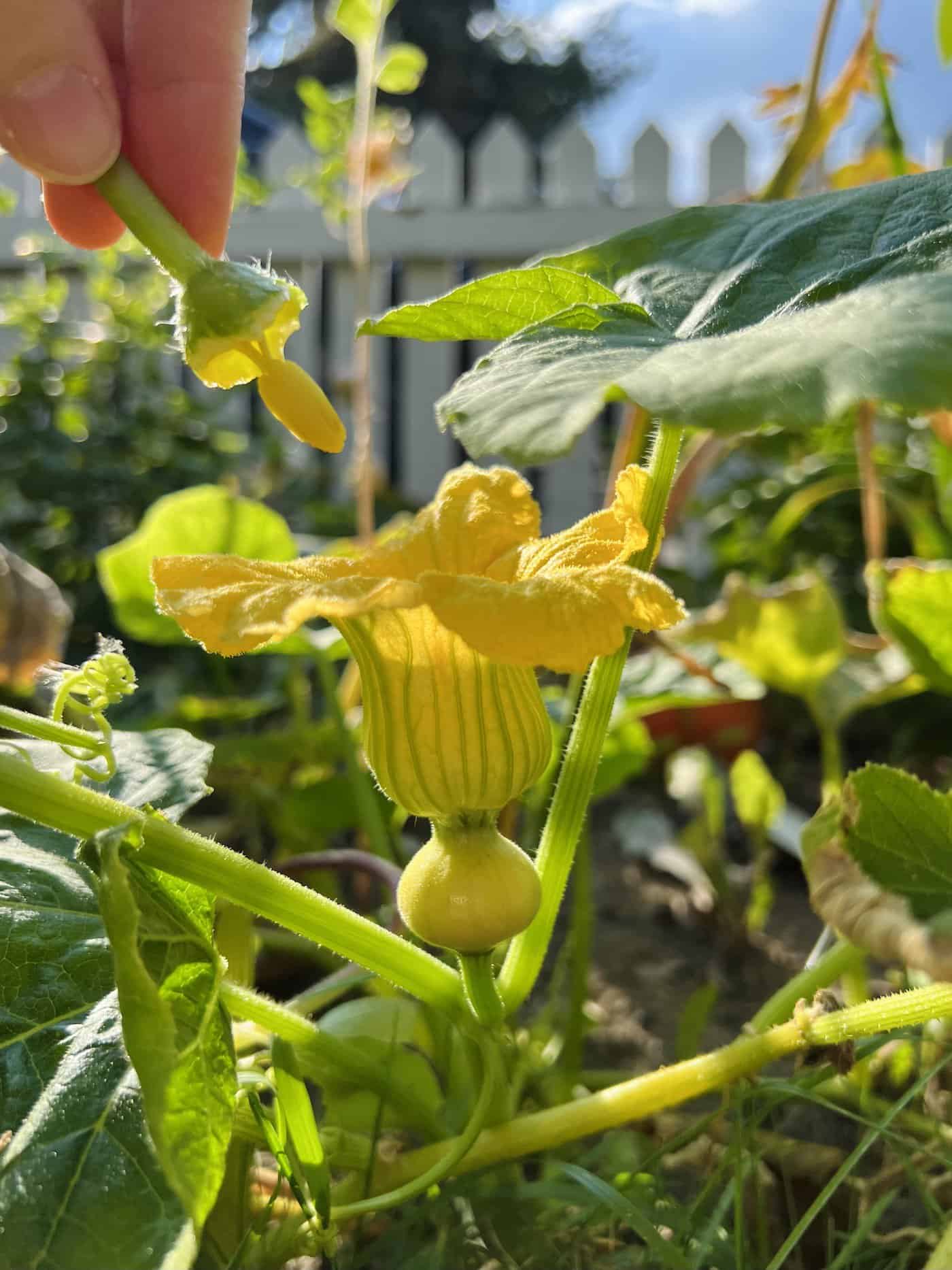
To pollinate a pumpkin, pick an open male flower in the morning, pull off its petals, and rub its pollen-covered center onto the sticky stigma inside an open female flower. Do it before about 11 a.m. on the one morning the female flower is open. Bees do the same job by making many visits, and a female flower needs about 8 to 12 bee visits (1,250 to 2,000 pollen grains) for full fruit set (Connecticut Agricultural Experiment Station).
Below, I cover how to tell male and female flowers apart, when to pollinate, the hand pollination steps, signs that pollination failed, why female flowers drop, and how to bring in more squash bees and bumble bees.
Do pumpkins need to be pollinated?
Yes. A pumpkin only forms when pollen moves from a male flower to a female flower. Pumpkins have separate male and female flowers on the same plant, and only the female flowers turn into fruit (Missouri Botanical Garden).
Wind can’t do this job. Pumpkin pollen is heavy and sticky, and the flowers are deep, so an insect (or you) has to carry it (NC State Extension). Bees are the main pollinators. In Connecticut field studies, the common eastern bumble bee was the most frequent visitor to pumpkin and winter squash flowers, followed by honey bees and squash bees.
You do not need two pumpkin varieties for fruit to set. One plant makes both flower types (UF/IFAS Extension).
How to tell male and female pumpkin flowers apart
Look just below the petals. A female flower has a tiny pumpkin (the ovary) between the petals and the vine. A male flower sits on a plain, slender stem with no swelling (Missouri Botanical Garden).

Then look inside. The female has a stigma with several sticky, shiny lobes. The male has a single anther (one upright spike) that looks dusty when it is shedding pollen (UF/IFAS Extension).
| Feature | Male flower | Female flower |
|---|---|---|
| Below the petals | Thin, plain stem | Small, round baby pumpkin (ovary) |
| Center of the flower | One spike (anther) covered in yellow pollen | Lobed, sticky stigma, often with 3 lobes |
| When it shows up | First, and in larger numbers | Later, and fewer of them |
| What happens after it opens | Wilts and falls off (normal) | Swells into a pumpkin if pollinated, or yellows and drops if not |

Why do I only have male flowers?
This is normal early in the season. The first flush of flowers is often all male, and those male flowers fall off after they shed pollen. The next flush should have both types (Purdue Extension). Pumpkin plants make many times more male flowers than female flowers over the season (Connecticut Agricultural Experiment Station).
Too much nitrogen can make this phase last longer. Extra nitrogen grows big vines but delays flowering (Purdue Vegetable Crops Hotline).
When to pollinate pumpkins: timing matters
Pumpkin flowers open at dawn and close by midday. Each flower, male or female, opens for one morning only (WSU Extension). Most pollination happens before 11 a.m. After that, most of the pollen is gone from the male flowers, the rest is losing viability, and the flowers start to close (Connecticut Agricultural Experiment Station).
| Time | What is happening | What to do |
|---|---|---|
| Evening before | Flowers that will open tomorrow are closed buds that start to show yellow | Spot the female buds you want to pollinate |
| Dawn | Flowers open. Squash bees start work before sunrise | Leave the bees to it if you see them |
| About 30 minutes later | Honey bees and bumble bees start to arrive | Watch for bee visits on female flowers |
| Mid-morning, once dew dries | Pollen is loose and plentiful | Best time to hand pollinate |
| By 11 a.m. | Pollen is mostly gone or losing viability | Finish hand pollinating |
| Midday | Flowers wilt and close for good | Too late for that flower |
For the “about 30 minutes” figure: USDA researchers found squash bees already working before sunrise, with honey bees and bumble bees arriving at least half an hour later (USDA Agricultural Research Service).
How to hand pollinate pumpkins step by step
Hand pollination helps when bees are scarce, the weather is cool or wet, or you want to be sure your first pumpkins set.
What you need
- An open female flower (baby pumpkin under the petals)
- One or more open male flowers from the same morning
- Clean scissors or pruners
- Optional: a small, soft paintbrush or cotton swab
Steps
- Go out in the morning. Wait until the dew dries, and finish before 11 a.m.
- Find an open female flower. Check for the baby pumpkin under the petals.
- Pick an open male flower. Cut it a few inches down its stem. Its anther should look dusty with yellow pollen.
- Pull off the male petals. This leaves the anther on its stem, like a small brush (Missouri Botanical Garden).
- Brush pollen onto every lobe of the stigma. Touch each lobe of the female’s stigma with the anther. Aim for a visible yellow coat on all lobes.
- Use a second male flower if you have one. Full fruit set takes 1,250 to 2,000 pollen grains, so more pollen helps.
- Mark the flower. A loose twist tie or a plant tag on the vine reminds you which ones you did.
- Check over the next few days. A pollinated ovary keeps swelling. An unpollinated one turns yellow, shrivels, and falls off.


A paintbrush or cotton swab works too. Twirl it on the male anther, then dab it on the stigma.
Hand pollinating for seed saving
Bees carry pollen between varieties, and the fruit still looks normal. The seeds inside are what change. If you want seeds that grow true to the parent, Seed Savers Exchange tapes both male and female buds shut the evening before they open. The next morning, they use about three male flowers per female, then close the female flower again so no bee gets in (Seed Savers Exchange). My guide on how to save pumpkin seeds covers what to do after harvest.
How do you know if a pumpkin was pollinated?
After pollination and fertilization, the ovary under the female flower starts to swell. If fertilization does not happen, the ovary withers away (Missouri Botanical Garden). The flower petals wilt either way, so judge by the baby pumpkin, not the flower.
Signs of poor pollination
- Baby pumpkins turn yellow and fall off. A female flower that was not pollinated on its one day will yellow, shrivel, and drop (WSU Extension).
- Low fruit set. Few of your female flowers become pumpkins. Count females, not all flowers, because males never make fruit (UF/IFAS Extension).
- Small or misshapen pumpkins. Too few pollen grains can give smaller, oddly shaped fruit (UF/IFAS Extension).
- Lopsided pumpkins. If seeds grow at only one end or one side, the pumpkin grows lopsided (Purdue Vegetable Crops Hotline).
- Fuzzy mold on a dead baby fruit. This is often Choanephora fruit rot. It tends to attack fruit that was dying anyway, so it is unlikely to be the first cause, and fungicides do not fix this kind of fruit loss (Purdue Vegetable Crops Hotline).
Why are my female pumpkin flowers falling off?
If male flowers fall off, that is normal. If female flowers or baby pumpkins fall off, something stopped pollination or the plant could not support the fruit. Here are the common causes.
| Cause | What you see | What to do |
|---|---|---|
| Not enough bee visits | Female opens, then the baby pumpkin yellows and drops | Hand pollinate in the morning. Add flowers for bees nearby |
| Hot or cold weather | Drops during heat waves or cold, wet spells | Hand pollinate when bees are not flying |
| High heat before bloom | Tiny dried female buds a few centimeters long hidden under leaves | Water well and keep plants unstressed. Some varieties handle heat better |
| Heat after pollination | Flower was pollinated but fruit still fails | High heat can block pollen tube growth. Nothing to fix but plant health |
| Plant is low on energy | Later fruits drop while the first ones grow | Normal. The first fruit gets priority. Control weeds, water in dry spells |
| Too much nitrogen | Huge vines, late female flowers | Cut back on high-nitrogen fertilizer |
| Insecticide on open flowers | Few bees, poor set after spraying | Avoid spraying blooms. If you must, spray in the evening |
Weather and pollen
Purdue Extension lists hot or cold temperatures and low bee activity as the most common reasons female flowers drop (Purdue Extension). Extreme heat or cold, high humidity, fog, or steady rain all reduce bee visits. High heat and humidity can also make pollen less viable (UF/IFAS Extension).
The plant decides how many pumpkins it can carry
Pumpkin plants make more female flowers than they can grow into fruit. The first fruit to set gets priority over later ones (Connecticut Agricultural Experiment Station). Hot nights, cloudy weather, leaf disease, and shade from weeds all cut the energy a plant has for fruit. Shading even the one leaf next to a female flower can lower fruit set for that flower (Purdue Vegetable Crops Hotline). If you want to know what a normal yield looks like, see how many pumpkins per plant.
How to attract squash bees and other pumpkin pollinators
Squash bees (Eucera pruinosa, also listed as Peponapis pruinosa) gather pollen only from squash, pumpkin, zucchini, and gourd flowers. It takes only 6 to 10 squash bee visits to fully pollinate a female squash flower. By some estimates, they pollinate about two-thirds of the squash grown commercially in the US (NC State Extension).

How to identify a squash bee
- Timing: they are on pumpkin flowers around sunrise, before other bees are active.
- Shape: bigger and bulkier than a honey bee, with longer antennae and a rounder face.
- Legs: females have fuzzy hind legs covered in loose pollen. Honey bees pack pollen into neat balls.
- Males: have a yellow spot on the face. Females have all-dark faces.
Source: NC State Extension. Male squash bees often sleep in pumpkin flowers after the flowers close at midday (USDA Agricultural Research Service).
Ways to help squash bees
- Don’t till the squash bed. Female squash bees dig nests 6 to 12 inches (15 to 30 cm) deep, often right under the plants, and the young stay sealed in those nests most of the year. One census of 25 farms found three times more squash bees on no-till farms (NC State Extension).
- Grow squash or pumpkins in the same area each year. Places with a history of squash growing tend to keep strong squash bee numbers (USDA Agricultural Research Service).
- Keep some bare, sunny soil. Ground-nesting squash pollinators need bare, sun-exposed soil that is not tilled often (UF/IFAS Extension).
- Keep mulch light. Squash bees dug through a 2-inch (5 cm) mulch layer in one small study of 4 nests.
- Water the bed. Squash bees were more common on irrigated farms, perhaps because moist soil is easier to dig.
- Skip systemic insecticides. Systemic products applied before bloom can show up in squash pollen. One study found an 89% drop in squash bee reproduction where squash got an imidacloprid soil drench (NC State Extension).
- Spray in the evening only, if you must spray. Bees are not active then. Carbaryl (Sevin) is highly toxic to bees (Purdue Extension).
Help bumble bees and other bees too
Bumble bees and sweat bees visit many kinds of flowers, so they need food before and after pumpkins bloom. Flowering plants, wildflowers, and even flowering weeds around the garden feed them through the season (UF/IFAS Extension). WSU Extension suggests a mix of flowers that bloom from early spring until late fall, plus nesting sites (WSU Extension).
For plant ideas, see my posts on planting a pollinator garden and companion plants for pumpkins.
Bee “attractant” sprays are not worth buying. In related crops (watermelon and cucumber), studies found they did not raise bee visits or yields (UF/IFAS Extension).
Pollinating pumpkins in cold climates (zones 3 to 6)
I garden in Armstrong, BC, in the North Okanagan (about zone 5b/6a). Pumpkins matter here. Our town has held the Harvest Pumpkin Festival since 2000, with a giant pumpkin weigh-in. The 2024 winner weighed 1,408 pounds (639 kg) (Tourism Armstrong Spallumcheen). Every one of those giants started as one female flower, open for one morning.
A few things are different in short, cool seasons:
- Don’t count on squash bees in the Pacific Northwest. USDA researchers once noted squash bees were missing from the Pacific Northwest. The first record of a squash bee there came in 2016, as the bee spread north with squash crops (WSU Extension). Bumble bees and honey bees may do most of the work in your garden.
- Cool, wet mornings slow bees down. Low temperatures and steady rain cut bee visits. Hand pollinate on those mornings.
- The first pumpkins count most. The first fruit gets priority, and a short season leaves little time for late fruit to ripen. Hand pollinate the first few female flowers to get an early start.
- Watch the calendar for your variety. Check the days to maturity on the seed packet and count back from your first fall frost. See how to grow pumpkins for planting dates and care.
Common pumpkin pollination mistakes
- Pollinating in the afternoon. The flowers close by midday, and the pollen has lost viability.
- Using a closed or old male flower. Use a male that opened that same morning, with dusty pollen.
- Dabbing one spot. Coat every lobe of the stigma.
- Panicking over early male flowers. Male flowers falling off is normal.
- Spraying open flowers. Insecticides on blooms harm the bees you need.
- Tilling the pumpkin patch every year. It can destroy squash bee nests in the soil.
Pumpkin pollination FAQ
How long are pumpkin flowers open?
One morning. They open at dawn and close by midday, and they do not open again.
What time of day is best to hand pollinate pumpkins?
Mid-morning, after the dew dries and before 11 a.m.
Can one male flower pollinate more than one female?
It can carry pollen to more than one, but each female needs a lot of pollen (1,250 to 2,000 grains for full fruit set). Use a fresh male, or two, for each female when you can.
Will cross-pollination change this year’s pumpkin?
No. Cross-pollination affects the seeds inside, not the pumpkin you harvest this year. It matters if you plan to save seeds (Iowa State University Extension).
Why are my baby pumpkins turning yellow?
The female flower was most likely not pollinated well, so the fruit yellows, shrivels, and drops. Heat, cold, plant stress, or too many fruits already on the vine can also cause it.
Do I need to hand pollinate pumpkins?
Not always. In Connecticut studies, hand-added pollen made no difference in fruit set or size where bees were active. Hand pollinate when you see few bees, during bad weather, or for seed saving.
Why does my pumpkin plant have flowers but no pumpkins?
Early on, the plant may have only male flowers. Later, heat, too much nitrogen, or poor pollination can stop female flowers from setting fruit.
Next time you’re in the garden early, take a minute to look inside a few pumpkin flowers. Once you can spot the females, you can make sure each one gets the pollen it needs on its one morning.
Seed companies I like
These are the seed companies I order from for my own garden.
- Botanical Interests: beautiful packets with growing notes printed inside
- High Mowing Organic Seeds: certified organic, grown in Vermont
- True Leaf Market: big selection of hybrids, microgreens, and cover crops
Some links earn me a commission at no cost to you. As an Amazon Associate I earn from qualifying purchases.


Leave a Reply