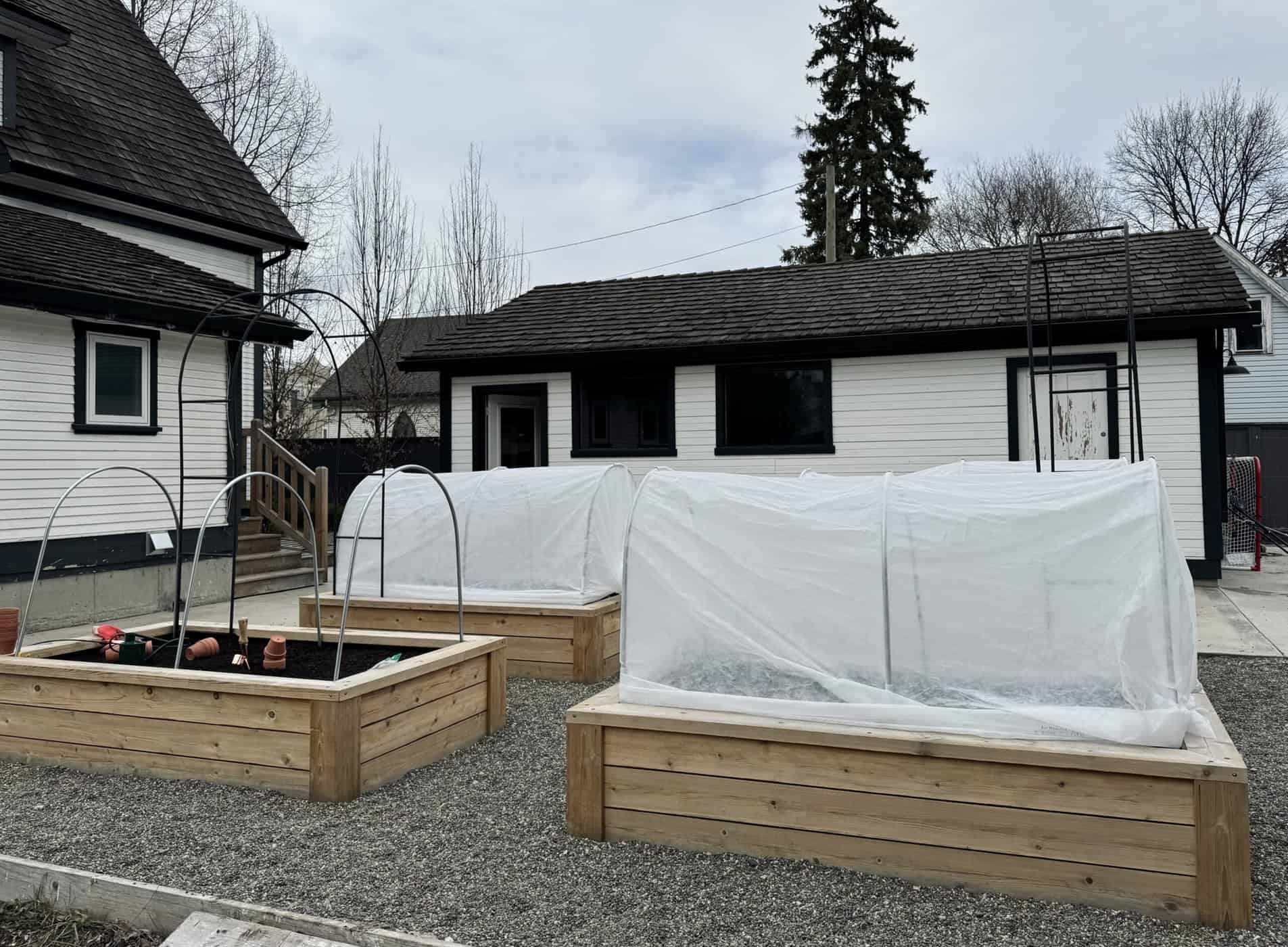
The old-fashioned pest control methods with the best research behind them are row covers, hand picking, a hard spray of water, trap crops, crop rotation, and a garden that feeds beneficial insects. Diatomaceous earth works in a narrow set of conditions. Many popular folk remedies, such as eggshell rings for slugs and marigolds planted between vegetables for nematodes, failed when researchers tested them.
Garden pest problems often begin before the insects show up. They begin with garden design. Long before modern pesticides, home gardens relied on simple habits that kept pests low before they took hold. None of these methods wipe out every insect. They keep pest numbers low enough that plants stay healthy and productive.
Below, each method gets an honest grade based on extension and university research. You will also find a pest-by-method table, a list of folk remedies that do not hold up, and notes for short, cold seasons like mine in the North Okanagan of BC.
Which old-fashioned pest controls work?
Here is the short version. The grades come from the sources linked in each section.
| Method | Research support | Best use | Main limit |
|---|---|---|---|
| Floating row covers | Strong | Flea beetles, cabbage caterpillars, cucumber beetles, onion maggot | Must come off squash and cucumbers at bloom |
| Hand picking | Strong for small gardens | Colorado potato beetle, squash bugs, hornworms, slugs | Takes steady scouting |
| Strong water spray | Good | Aphids, spider mites on sturdy plants | Pests return, so repeat it |
| Trap crops | Good for certain pests | Cucumber beetles (Blue Hubbard squash), flea beetles (mustards, collards) | Low to moderate pest numbers only |
| Crop rotation | Good for soil-dwelling stages | Colorado potato beetle, flea beetles, soil diseases | Flying pests cross a small garden with ease |
| Beneficial insect habitat | Good | Aphids and other soft-bodied pests | Predators arrive after pests build up |
| Cutworm collars | Good | Cutworms on transplants | Only protects the stem |
| Companion planting | Mixed | Mixed plantings that hide crops, flowers for predators | Many popular pairings have no evidence |
| Diatomaceous earth | Limited | Crawling insects in dry weather | Fails when wet and kills beneficial insects |
Floating row covers stop pests before they land
Some of the most reliable pest controls are physical. A floating row cover is a light fabric that lets in light, water, and air but keeps insects off the crop. University of Wisconsin Extension lists the pests it can stop:
- Imported cabbageworm, cabbage looper, and diamondback moth caterpillars on cabbage, broccoli, and cauliflower
- Flea beetles on cabbage, potato, eggplant, and leafy greens
- Onion maggot on onions
- Early cucumber beetles on squash, cucumbers, and melons
- Thrips, and the leafhoppers that spread aster yellows to carrots and lettuce

How to use row covers for pests
- Put the cover on at planting, before pests arrive. A cover placed over insects traps them inside with your crop.
- Bury the edges under soil on all sides. Wind lifts loose edges, and beetles walk right in.
- Leave slack so the fabric can rise as plants grow. Use hoops over tall or tender crops like broccoli and spinach.
- Uncover squash, cucumbers, and melons when they start to flower so bees can pollinate them.
- Lift the cover now and then to pull weeds. They grow well under fabric too.
Rotate crops when you use covers. Flea beetles, onion maggots, and seedcorn maggots spend the winter in garden soil. If you cover a crop in the same spot as last year, the pests come up under the fabric and feed with no predators around. Wisconsin Extension warns that this can make damage worse.
Watch the heat. Heavy covers can raise daytime temperatures 10°F (about 6°C) or more, and tomatoes and peppers may drop blossoms when it tops 86°F (30°C) underneath. On potatoes, the University of Minnesota Extension advises removing covers once heat and humidity rise, since they can promote disease.
Other barriers that work
Cutworm collars. Cutworms chew through young stems at the soil line. Michigan State University Extension recommends collars of folded newspaper, cardboard, or foil around each transplant stem. Make them 2 to 3 inches (5 to 8 cm) tall and push them into the soil so cutworms cannot go over or under. Paper can stay until it breaks down. Take foil out later.
Netting. Bird netting over berries and fruit is an exclusion device too. It works because it blocks damage outright instead of trying to scare pests off.
Hand picking garden pests
Hand picking sounds too simple to matter, but extension services rate it well for small gardens. Oklahoma State University Extension calls it the least expensive natural control if you leave out labor. It works best on large, slow, leaf-eating pests such as squash bugs, hornworms, bean beetles, and cabbage caterpillars.
The catch is timing. You have to pick before damage is easy to see, which means checking plants on a schedule. Look under leaves for egg clusters, since one egg mass removed is a whole batch of larvae that never hatch.

Hand picking Colorado potato beetles
The University of Minnesota says hand picking is effective in small gardens, most of all in spring as adults come out of the soil. Each female can lay up to 350 eggs, so every early adult you catch matters.
- Drop adults and larvae into a pail of soapy water.
- Crush the yellow-orange egg clusters on the undersides of leaves.
- Keep checking. New adults can fly in from other gardens.
You do not need a spotless plant. Potatoes can handle up to 30 percent leaf loss before flowering, but only about 10 percent once tubers start to size up, according to the same source. Pick hardest in the weeks after bloom.
Board traps for squash bugs and slugs
Pests that hide by day will gather under a flat board. Oklahoma State describes the old shingle trap: lay shingles under squash plants, then lift them often and destroy the squash bugs underneath. For slugs, the UC Statewide IPM Program suggests boards about 12 by 15 inches (30 by 38 cm), raised on 1-inch (2.5 cm) runners. Scrape off the slugs every day. UC IPM also says to hand pick slugs at night, when they feed.
Beer traps catch slugs too, but UC IPM notes they only attract slugs within a few feet. You need several, buried at ground level, with fresh bait every few days. For a full slug plan, see how to get rid of slugs in the garden.
Spraying aphids and spider mites off with water
A hard stream from the garden hose is one of the oldest tricks, and it holds up. The UC IPM aphid guide says most aphids knocked off a plant cannot climb back on, and the spray rinses off their sticky honeydew too. Oklahoma State adds that water sprays dislodge spider mites as well.

- Use it on sturdy plants only. Seedlings and soft growth can break.
- Spray in the morning so leaves dry fast. Wet leaves overnight invite disease like black spot on roses.
- Hit the undersides of leaves, where aphids and mites gather.
- Repeat every few days. Some pests always return.
Check plants at least twice a week while they grow fast, says UC IPM. Aphids can go from newborn to adult in seven to eight days in warm weather, and each adult can produce up to 80 young in a week. Many aphids do the most harm in late spring at 65 to 80°F (18 to 27°C). Learn more in our guides to aphids and spider mites.
Trap crops draw pests away from vegetables
Trap cropping uses a pest’s own taste against it. You plant something the pest likes more than your main crop, and the pest gathers there. Then you deal with the pests in one small area. Research supports a few specific pairs.
Blue Hubbard squash for cucumber beetles
A ring of ‘Blue Hubbard’ squash around summer squash can protect it from low to moderate numbers of striped and spotted cucumber beetles and squash vine borers. In early trials, UConn Extension found this perimeter trap crop cut cucumber beetle numbers on summer squash by up to 95 percent and squash vine borer by up to 88 percent. That matters because cucumber beetles spread bacterial wilt.
- Plant the trap crop all the way around the main crop. Gaps larger than 15 feet (4.5 m) let beetles through.
- In dry soil, sow the Hubbard seed one week before the main crop, since the large seeds take longer to sprout.
- Check the trap plants twice a week. Hand pick or treat the beetles there before they spread.
- Do not mix in other squash types. Zucchini draws beetles more than yellow squash and may need its own attention.
UConn notes this system works in plots as small as 20 by 20 feet (6 by 6 m). The trap only holds pests. If beetles build up on it and nobody removes them, they spread back into the main crop.
Mustards and collards for flea beetles
Washington State University Extension reports that a mix of ‘Pacific Gold’ mustard, ‘Dwarf Essex’ rape, and pac choi protected broccoli from crucifer flea beetles. A border of collards also protected broccoli in studies. WSU suggests giving the trap crop about 10 percent of your crop area and letting it grow 2 to 4 weeks before you plant the main crop. The trap worked the same at 1.6 feet (0.5 m) away as at 36 feet (11 m).
Keep the trap crop lush. Once it flowers, sets seed, or dries out, the beetles leave it for your broccoli. Trim off flowers to keep it attractive.
Not every trap crop holds up. The University of Minnesota found that eggplant trap crops did not reduce Colorado potato beetle numbers in on-farm trials. Stick with pairs that extension trials have tested, like the two above.
Does crop rotation control pests?
Yes, for pests that spend part of their life in the soil. When the same plant family grows in one spot year after year, overwintering pests come up next spring right beside their food. Wisconsin Extension recommends waiting three to four years before planting the same family in the same spot. Even a one-year change helps.
| Plant family | Vegetables to rotate together |
|---|---|
| Nightshade | Tomato, potato, pepper, eggplant |
| Mustard (brassicas) | Broccoli, cabbage, cauliflower, kale, radish, turnip |
| Gourd | Cucumber, squash, pumpkin, melons |
| Onion | Onion, garlic, leek, chives |
| Pea | Peas and all beans |
| Carrot | Carrot, celery, parsley, parsnip |
| Goosefoot | Beet, spinach, Swiss chard |
The limit of rotation in a small garden
Distance is what makes rotation work against insects. Colorado potato beetles spend the winter 5 to 10 inches (13 to 25 cm) deep in the soil. The University of Minnesota says farms reduce early beetles by planting at least a quarter mile (400 m) from last year’s potatoes. UConn found that rotating cucumber beetle crops within the same field, or to the next field, did not reduce beetle numbers. It suggests half a mile (800 m).
Most home gardens are far smaller than that. In a backyard garden, every bed sits well inside those distances. In a small garden, rotation still helps with soil diseases and with pests that stay put, like the tuber flea beetle larvae that WSU found build up where potatoes grew the year before. For mobile pests, pair rotation with a row cover or skip that crop for a year. Minnesota notes that a year with no potatoes can lower local beetle numbers, most of all when no one nearby grows them.
For more on potato pests and planting partners, see 19 companion plants for potatoes.
Beneficial insects: the garden’s own pest control
Old gardens seldom held only vegetables. Flowers, herbs, and berries grew alongside the food crops. That mix gave beneficial insects places to feed and shelter, and research supports it.
UC IPM lists the main aphid enemies: lady beetles, lacewing larvae, syrphid fly larvae, soldier beetles, and tiny parasitic wasps. The wasps turn aphids into swollen tan or golden “mummies.” Once you see mummies, UC IPM says the aphid population often drops a great deal within a week or two. WSU adds that lacewing larvae, big-eyed bugs, and damsel bugs eat adult flea beetles.

How to keep beneficial insects in the garden
- Plant flowers for nectar and pollen. WSU names anise, dill, chamomile, marigold, and clover as plants that feed the native parasitic wasps and other predators.
- Skip broad-spectrum sprays. UC IPM notes that these kill natural enemies along with pests, which can make aphid problems worse later.
- Keep ants off aphid-infested plants. Ants guard aphids from predators to protect their honeydew supply.
- Tolerate a few pests. Predators show up after aphids build up, so a small infestation feeds the crew that controls the next one.
- Mulch. Linda Chalker-Scott of WSU notes that arborist wood chip mulch houses predatory spiders and ground beetles.
Is buying ladybugs worth it?
Usually not. The convergent lady beetles sold by mail are collected from their winter clusters in the wild. UC IPM says most fly away within one or two days of release, even when aphids are plentiful. Controlling aphids on one rose bush took about 1,500 beetles, released again every one to two weeks. Habitat for the lady beetles already in your area is the cheaper path.
Does companion planting work for pest control?
Partly. Some companion planting rests on sound science. Much of what circulates online does not. Linda Chalker-Scott, the WSU Extension urban horticulturist, wrote the peer-reviewed bulletin Gardening with Companion Plants to sort the two apart.
What the evidence supports:
- Mixing crops. Chalker-Scott advises spacing plants of the same species as far apart as you can so a pest cannot sweep through a whole crop.
- Hiding host plants. Flea beetles find hosts by sight and smell. WSU lists green onions, dill, and marigolds as companions used to make brassicas harder to find.
- Flowers that feed predators. This is the beneficial insect habitat described above.
- Trap crops. These are a form of companion planting with real trial data.

What it does not support: charts that claim one plant “loves” another, or that a single herb repels a long list of pests. Treat those as untested. Our 21 companion plants for tomatoes shows how mixed plantings with herbs and flowers can fit around one crop.
Does diatomaceous earth work in the garden?
Only in a narrow window. Diatomaceous earth (DE) is ground fossil algae. Its sharp edges scratch the waxy coat of soft-bodied insects, and they dry out and die. The National Pesticide Information Center says it stays effective only while it is dry and undisturbed.
- Dew, rain, and watering cut its effect. Oklahoma State says it works less well in humid weather.
- It does not pick targets. It can kill lady beetles and other beneficial insects too.
- Pool filter DE does not work. Heat treatment changes it so it no longer absorbs insect oils.
- Buy a product labeled for insects and for vegetables, and wear a dust mask when you apply it.
Keep DE off flowers where bees forage. If you use it, dust it in a thin band on dry soil where crawling pests travel, not over the whole plant.
Healthy soil, without the overfeeding
Strong plants tolerate some insect feeding. Compost improves soil structure, holds moisture, and supports steady growth. Making your own is simple, and our guide on how to compost covers the basics.
More fertilizer is not better. UC IPM warns that high nitrogen favors aphid reproduction. It recommends slow-release sources such as compost or organic fertilizer in small amounts through the season.
Pest-by-method table
Find your pest, then start with the first column. Sources are linked in the sections above.
| Pest | Start with | Also helps | Weak or unproven |
|---|---|---|---|
| Aphids | Water spray, natural enemies | Row covers on seedlings, less nitrogen, ant control | Bought ladybugs |
| Colorado potato beetle | Hand picking, row cover with rotation | Early varieties, straw mulch, a year without potatoes | Eggplant trap crop |
| Cucumber beetles | Row cover until bloom | Blue Hubbard perimeter trap crop, long-distance rotation | Rotating within a small garden |
| Flea beetles | Row cover at planting | Mustard or collard trap crop, mixed plantings, later planting | Crop rotation alone |
| Cabbage caterpillars | Row cover | Hand picking | None tested here |
| Squash bugs | Hand picking, board traps | Crushing egg clusters | None tested here |
| Hornworms | Hand picking | Scouting every few days | None tested here |
| Cutworms | Collars on transplants | None tested here | None tested here |
| Slugs | Hand picking at night, board traps | Beer traps (short range) | Eggshells, grit, wool pellets |
| Spider mites | Water spray | Sparing predatory mites (soaps kill them) | Dish soap mixes (plant damage risk) |
| Root-knot nematodes | Rotation | Solid planting of French marigolds two months before the crop | Marigolds tucked between plants |
Folk remedies that research does not support
Some old tips survive because they are easy to try, not because they work. These are the ones with tests behind the verdict.
Eggshells, grit, and copper tape for slugs
The Royal Horticultural Society grew 108 lettuces for six weeks in pots and raised beds. It ringed them with crushed eggshells, pine bark mulch, copper tape, sharp grit, or wool pellets. The RHS found no difference in damage between protected lettuces and those with no barrier. Some lab studies show copper repels slugs, and UC IPM still suggests copper strips 2 inches (5 cm) tall, buried 1 to 2 inches (2.5 to 5 cm) deep. In a real garden, though, do not count on it.
Marigolds between vegetables for nematodes
Marigolds can suppress root-knot and lesion nematodes, but not the way most people plant them. The University of Florida IFAS says marigolds tucked between crops do not appear to reduce nematodes. To work, French marigolds (Tagetes patula) must grow as a dense planting in the same spot for at least two months before the vegetable crop. They also increase some other nematode types.
Homemade dish soap sprays
Soap does kill soft-bodied pests like aphids and mites. The trouble is plant damage. Oklahoma State notes that household soaps and detergents are not made for plants, many are poor insecticides, and clothes detergents are too harsh. It recommends commercial insecticidal soap over homemade mixes. Test any spray on a few leaves a day or two first, and do not spray above 90°F (32°C).
“Plant this herb and pests stay away”
Single-plant repellent claims are the weakest part of companion planting lore. Chalker-Scott describes the popular version as pseudoscience and points readers to effects that can be measured instead: shade, mulch, root competition, and habitat for predators.
Notes for cold climates (zones 3 to 6)
- Row covers do double duty. Wisconsin Extension says covers add 2 to 8°F (about 1 to 4°C) of warmth. Heavy covers give 4 to 8°F (about 2 to 4°C) of frost protection. In a short season, one cover handles spring frost and flea beetles together.
- Catch potato beetles early. The University of Minnesota notes Colorado potato beetles cannot move far before temperatures reach 70°F (21°C). Cool spring weeks are the best time to hand pick the first adults.
- Grow fast potatoes. Minnesota suggests varieties that mature in under 80 days to escape midsummer beetle damage.
- Time brassicas around flea beetles. WSU suggests planting brassicas in mid to late July to dodge the overwintered beetles. In the north, that suits a fall crop of kale or cabbage.
- Fewer generations help. WSU reports one generation a year of crucifer flea beetle in Washington, and Minnesota notes a second potato beetle generation is common only in the southern and central parts of that state. Shorter seasons mean fewer pest cycles to fight.
Common mistakes with natural pest control
- Covering a crop in the same bed where its pests spent the winter.
- Leaving row covers on squash and cucumbers after flowers open, then getting no fruit.
- Planting a trap crop and never checking it, so it becomes a pest nursery.
- Dusting DE on wet leaves or on flowers where bees feed.
- Spraying a broad insecticide at the first aphid and killing the predators that would have cleaned them up.
- Waiting for visible damage before scouting. By then, egg masses have hatched.
FAQ
What is the most effective natural pest control for a vegetable garden?
Floating row covers put on at planting. They block flea beetles, cabbage caterpillars, cucumber beetles, and onion maggots outright, with no spray needed. Pair them with crop rotation.
Do marigolds keep bugs away?
Not as a general repellent. Their flowers can feed beneficial insects, and WSU lists them as a companion for flea beetle management. For nematodes, they only help as a dense planting grown two months before the crop.
Do crushed eggshells stop slugs?
No. An RHS garden trial found eggshell rings did not reduce slug damage on lettuce. Hand picking at night and board traps are better options.
Is diatomaceous earth safe for bees?
No. DE kills insects by contact and does not tell pests from beneficial insects. Keep it off flowers and use it only in dry spots where crawling pests travel.
Does spraying plants with water get rid of aphids?
Yes, on sturdy plants. UC IPM says most aphids knocked off cannot return. Spray in the morning and repeat every few days.
How many years should I rotate crops?
Three to four years between crops of the same family in one spot, according to Wisconsin Extension. Even a one-year change helps.
When do I take row covers off squash and cucumbers?
When the first flowers open. Bees need to reach the flowers to pollinate them.
Is hand picking worth the time?
In a small garden, yes. Extension services rate it effective for potato beetles, squash bugs, and hornworms. It works best early, before eggs hatch.
Start this season with two habits: cover your brassicas and young squash at planting, and walk the garden twice a week to pick pests and egg masses. For help naming what you find, see our guide to common garden pests.
Seed companies I like
These are the seed companies I order from for my own garden.
- Botanical Interests: beautiful packets with growing notes printed inside
- High Mowing Organic Seeds: certified organic, grown in Vermont
- True Leaf Market: big selection of hybrids, microgreens, and cover crops
Some links earn me a commission at no cost to you. As an Amazon Associate I earn from qualifying purchases.



Leave a Reply