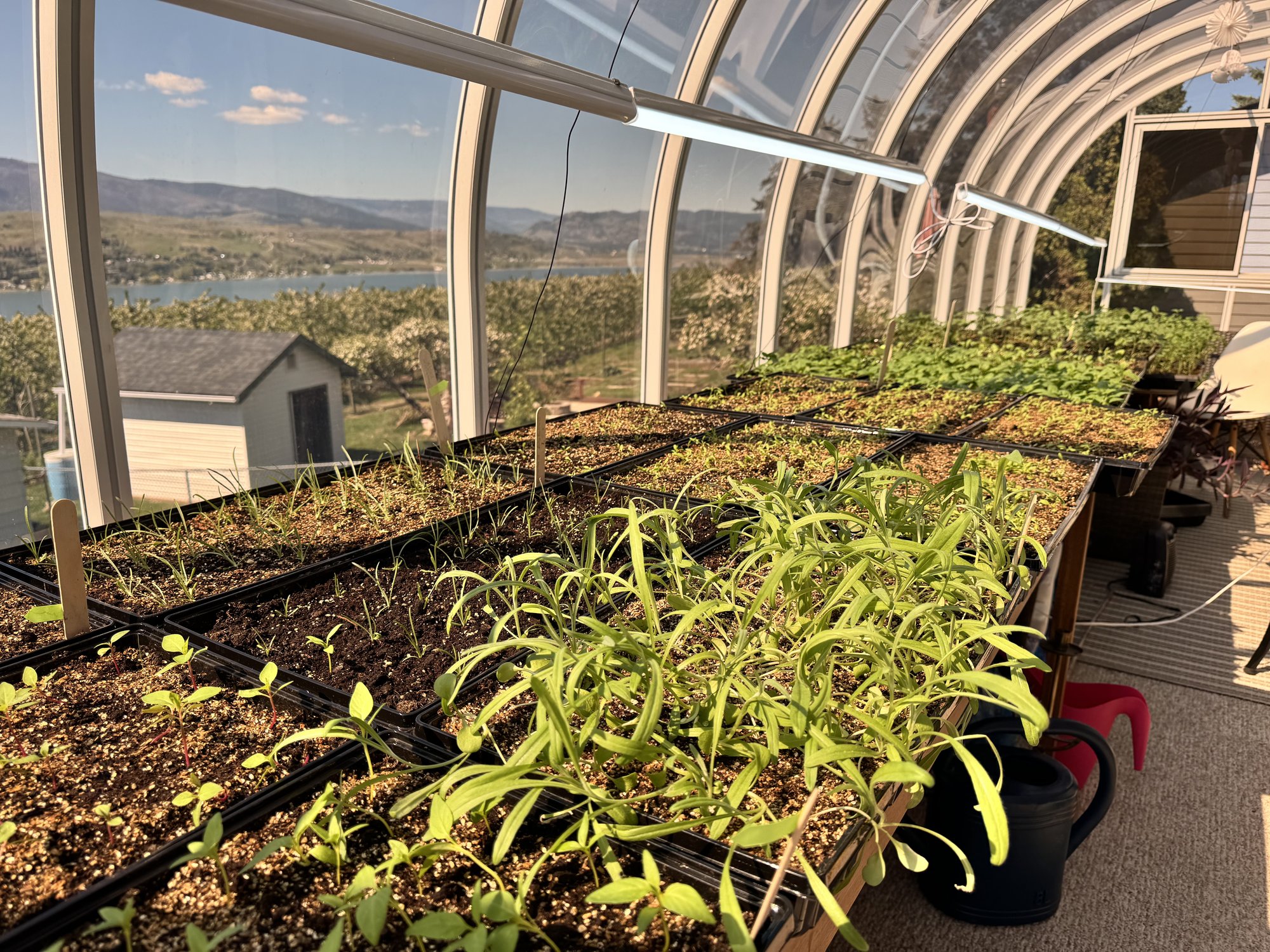
The seed-starting mistakes that kill the most seedlings are too little light, too much water, and the wrong temperature. Weak light makes seedlings tall and floppy. Wet, cool potting mix invites damping off, a disease that can kill a whole tray. Most fixes are simple: keep fluorescent lights 2 to 4 inches above the leaves for 12 to 16 hours a day, water only when the surface dries, and keep the mix near 70°F to 75°F (21°C to 24°C) until seeds sprout.
Below are the eight most common mistakes, what each one looks like, and how to fix it. There is a germination temperature table by crop and a symptom-to-cause table near the end, so you can match what you see in your tray to what went wrong.
Quick list: the 8 most common seed-starting mistakes
- Too little light, or lights hung too high. This causes leggy, pale seedlings.
- Overwatering and soggy trays. This drowns roots and feeds disease.
- Damping off from dirty trays, reused mix, or garden soil.
- Wrong temperature: too cool to germinate, or too warm after sprouting.
- Planting seeds too deep, or burying seeds that need light.
- Using old seed without a germination test.
- Fertilizing too early or too late, or at full strength.
- Skipping hardening off before planting outside.
Starting seeds in the wrong mix
This mistake happens before a single seed sprouts. Garden soil and heavy potting soil hold too much water and pack down in small cells. That leaves little air around young roots.
Seeds germinate best in a loose, sterile seed-starting mix. Most are made of fine peat or coir with vermiculite or perlite for air space. The University of Minnesota Extension recommends commercial soilless seed-starting mixes because they are sterile, light, and free of weed seeds (UMN Extension).
Garden soil and compost can carry the fungi that cause damping off. UMN Extension advises against using garden soil, compost, or reused potting mix in seed trays (UMN Extension, damping off). Use fresh mix every season.
For a full walk-through of mixes, containers, and timing, see my seed starting guide.
Mistake 1: Not enough light (why seedlings get leggy)

Leggy seedlings have long, thin stems, wide gaps between leaves, and a pale color. They lean toward the nearest light. The plant is stretching to find more light, a process called etiolation. Lack of light is the most common cause of leggy seedlings, according to University of Illinois Extension.
Why a sunny window is not enough
A windowsill is a poor place to start seeds. UMN Extension notes that windowsills are the coldest spot in the house at night and the hottest in the day, and seedlings grown there tend to be tall with thin, bent stems. Spring sunlight in northern regions is weak compared to grow lights kept close to the plants, and cloudy days cut it further (UMN Extension).
How far should grow lights be from seedlings?
Distance matters. Light gets weaker as the fixture moves away from the leaves.
- Fluorescent tubes (T5, T8): 2 to 4 inches (5 to 10 cm) above the tops of the seedlings. UMN Extension says to keep them no more than 4 inches above, with 2 inches as ideal (UMN Extension).
- General guidance for grow lights: Iowa State University Extension gives 4 to 6 inches (10 to 15 cm) above the plants (Iowa State Extension).
- LED fixtures: output varies a lot by model. Check the maker’s chart for the light level at each hanging height, and start at the closest height it lists for seedlings.
- Hours: 12 to 16 hours of light a day. Do not leave lights on around the clock, since many plants need a dark period each night. A plug-in timer handles this for you (UMN Extension).
Hang lights from chains or adjustable cords. Raise them as the seedlings grow so the gap stays the same. Fluorescent tubes also lose brightness as they age, so old tubes can cause stretching even at the right distance (Illinois Extension).
Daily light integral (DLI): how much light seedlings need
Daily light integral, or DLI, is the total amount of usable light a plant gets in one day. It combines how bright the light is and how many hours it runs. DLI is measured in moles of light per square meter per day (mol·m-2·d-1).
Purdue University’s Vegetable Crops Hotline lists these DLI targets for vegetable transplants (Purdue Extension):
| Crop | Target DLI (mol·m-2·d-1) | Light level needed over 16 hours (µmol·m-2·s-1) |
|---|---|---|
| Lettuce | 10 to 15 | about 175 to 260 |
| Cabbage | 10 to 15 | about 175 to 260 |
| Cucumber | 10 to 15 | about 175 to 260 |
| Squash | 10 to 15 | about 175 to 260 |
| Tomato | 15 to 20 | about 260 to 350 |
| Pepper | 15 to 20 | about 260 to 350 |
| Eggplant | 15 to 20 | about 260 to 350 |
The third column is my math using the formula from Virginia Cooperative Extension: DLI equals the light level (PPFD) times 3,600 times the hours of light, divided by 1,000,000. Their example: 200 µmol·m-2·s-1 for 16 hours gives a DLI of about 11.5. If your LED maker lists PPFD at each hanging height, you can use this to pick a height. A PAR meter gives an exact reading.
Purdue notes that low DLI causes delayed or uneven germination, poor roots, and stretched, weak stems. Seedlings grown in the target range are compact, with short, thick stems and good roots (Purdue Extension).
Other causes of leggy seedlings
- Crowding. Too many seedlings in one cell compete for light and stretch. Sow a few seeds per cell and thin early (Illinois Extension).
- Starting too early. Seedlings started too soon get large and lanky before it is warm enough to plant out, and lanky seedlings do not transplant well (Iowa State Extension).
- Too much heat after sprouting. See Mistake 4 below.
Can you save leggy seedlings? Tomatoes can be set deeper when you pot them up or plant them out, since they root along the buried stem (Purdue Yard and Garden). For most other crops, fix the light and the new growth will be sturdier. If the stems are flopping over, starting again with better light is often faster.
Mistake 2: Overwatering seedlings
Too much water is one of the most common reasons seedlings die. Waterlogged mix has little oxygen, so roots begin to die back. The seedlings then wilt, which leads many gardeners to water even more (Illinois Extension).
Newly sprouted seedlings have small root systems and do not use much water. They rarely need water every day. Keep the mix moist but not wet.
How to water seedlings the right way
- Water when the surface of the mix feels dry to the touch, then water thoroughly (Iowa State Extension).
- Bottom water: set the tray in water and let the mix soak it up from below. This keeps tiny seeds and stems from washing out.
- Drain any water left standing in the tray after watering (UMN Extension).
- Use room-temperature water, 68°F to 77°F (20°C to 25°C). Cold water near 50°F (10°C) slows growth and raises the risk of infection (UMN Extension).
- Take off the humidity dome as soon as seeds sprout (Iowa State Extension).
Fungus gnats and green algae on top of the mix are signs the mix stays too wet. Cut back on water and let the surface dry out (Illinois Extension).
Mistake 3: Ignoring damping off
Damping off is a disease of young seedlings. It is caused by the fungi Rhizoctonia and Fusarium and the water mold Pythium. Infected seedlings rarely recover, and it often kills a large part of a tray or the whole tray (UMN Extension).
Damping off symptoms
- Seeds never come up.
- Seedlings look healthy, then fall over at the soil line.
- The stem at the soil line is thin, almost like a thread, and water-soaked.
- Stems and seed leaves turn soft, mushy, and gray to brown.
- White, cobweb-like growth on the seedlings when the air is humid.
Source: UMN Extension and Illinois Extension.
What causes damping off
The pathogens live in soil and plant debris. They get into trays on reused pots and mix, dirty tools, hose ends that touch the ground, and fungus gnats. Cool, wet conditions favor them. UMN Extension lists low light, overwatering, high salts from too much fertilizer, and cool soil as conditions that raise the risk (UMN Extension).
How to prevent damping off
- Soak used pots and trays for 30 minutes in a 10% household bleach solution (1 part bleach to 9 parts water), then rinse (UMN Extension).
- Use new seed-starting mix. Do not reuse mix or use garden soil or compost.
- Warm the mix to 70°F to 75°F (21°C to 24°C) with a seedling heat mat.
- Water only when needed, and drain the tray.
- Give 12 to 16 hours of light a day.
- Hold off on fertilizer until seedlings have several true leaves.
- Keep air moving around the trays. Iowa State Extension says ventilation and air circulation help prevent damping off (Iowa State Extension).
Once seedlings have true leaves and a larger root system, they are far less likely to be infected (Illinois Extension). If damping off strikes, throw out the affected cells and the mix, and clean the tray before you sow again.
Mistake 4: Wrong temperature for germination and growth

Seeds need warmth to sprout, but each crop has its own range. Cool mix slows germination and makes seedlings more likely to get damping off. Most seeds germinate best in mix that is about 70°F to 75°F (21°C to 24°C), according to Illinois Extension.
Potting mix in a tray can run as much as 5°F (about 3°C) cooler than the room air (UMN Extension). A heat mat makes up the difference. Do not plug the heat mat into the same timer as your lights, or the mix will cool every night.
Germination temperature by crop
This table comes from Oregon State University Extension. Temperatures are soil (mix) temperatures. The last column shows how many days the seeds took to come up at 77°F (25°C).
| Crop | Minimum | Optimum range | Best | Days to emerge at 77°F (25°C) |
|---|---|---|---|---|
| Tomato | 50°F (10°C) | 60°F to 85°F (16°C to 29°C) | 85°F (29°C) | 6 |
| Pepper | 60°F (16°C) | 65°F to 95°F (18°C to 35°C) | 85°F (29°C) | 8 |
| Eggplant | 60°F (16°C) | 75°F to 90°F (24°C to 32°C) | 85°F (29°C) | 5 |
| Lettuce | 35°F (2°C) | 40°F to 80°F (4°C to 27°C) | 75°F (24°C) | 2 |
| Onion | 35°F (2°C) | 50°F to 95°F (10°C to 35°C) | 75°F (24°C) | 4 |
| Parsley | 40°F (4°C) | 50°F to 85°F (10°C to 29°C) | 75°F (24°C) | 13 |
| Spinach | 35°F (2°C) | 45°F to 75°F (7°C to 24°C) | 70°F (21°C) | 5 |
| Pea | 40°F (4°C) | 40°F to 75°F (4°C to 24°C) | 75°F (24°C) | 6 |
| Carrot | 40°F (4°C) | 45°F to 85°F (7°C to 29°C) | 80°F (27°C) | 6 |
| Cucumber | 60°F (16°C) | 60°F to 95°F (16°C to 35°C) | 95°F (35°C) | 4 |
| Squash | 60°F (16°C) | 70°F to 95°F (21°C to 35°C) | 95°F (35°C) | not listed |
| Muskmelon | 60°F (16°C) | 75°F to 95°F (24°C to 35°C) | 90°F (32°C) | 4 |
Source: Oregon State University Extension, soil temperature conditions for vegetable seed germination.
Cool temperatures make a big difference. In the same Oregon State data, pepper seeds took 25 days to come up at 59°F (15°C), but only 8 days at 77°F (25°C). Tomato seeds took 43 days at 50°F (10°C) and 6 days at 77°F. If your peppers seem to be doing nothing, a cold basement is a likely reason. For more crops and tips, see the best temperature to germinate seeds.
Keeping seedlings too warm after they sprout
Once seeds come up, most seedlings grow best a little cooler. Iowa State Extension says the best growing temperature for a seedling is about 10°F (about 6°C) cooler than its best germination temperature (Iowa State Extension). Too much warmth after germination pushes soft, fast growth.
Move trays off the heat mat once most seeds have sprouted. Keep the room above 60°F (16°C) (UMN Extension).
Mistake 5: Planting seeds too deep

A seed carries only enough stored food to reach the surface. Plant it too deep and it can run out of energy first. Seeds planted too deep may also miss the light some of them need to sprout (Iowa State Extension).
- General rule: plant a seed about two times as deep as its width. Another way to picture it: deep enough that one more seed would fit on top of it (UMN Extension).
- Iowa State’s version: cover seeds with mix one to two times the seed’s diameter (Iowa State Extension).
- Tiny seeds and seeds that need light: press them onto the surface and do not bury them. Lettuce, dill, snapdragons, and coleus need light to germinate (Illinois Extension). A light dusting of fine vermiculite keeps them moist and still lets light through (UMN Extension).
- Seeds that need darkness: cover the tray with a dark bag or a few layers of newspaper until they sprout (UMN Extension).
The seed packet is the best guide. Seed size and shape vary a lot, and my article on types of seeds explains how those traits affect planting depth.
Mistake 6: Using old seed without testing it
Seeds lose their ability to sprout over time. Fewer and fewer seeds from a packet will germinate each year. UMN Extension suggests not buying more seed than you will use in two or three years (UMN Extension).
How long do seeds last?
University of Illinois Extension gives these ranges for seeds stored well (Illinois Extension):
| How long seeds last | Crops |
|---|---|
| 4 to 5 years | basil, broccoli, cabbage, cauliflower, cucumber, eggplant, lettuce, radish, squash, pumpkin, tomato, watermelon, cosmos, nasturtium, snapdragon, sunflower, zinnia |
| 3 years | bean, carrot, pea, pepper, okra, celosia, poppy |
| 1 to 2 years | onion, parsnip, sweet corn, fennel, sage, aster, coneflower, pansy |
How to do a germination test
- Place 10 seeds on a damp paper towel.
- Fold the towel over the seeds and seal it in a plastic bag. Label it with the crop and date.
- Keep it somewhere warm, above 70°F (21°C).
- Check after 7 to 10 days and count the seeds that sprouted.
If 7 to 9 of 10 sprout, the seed is fine. Sow two seeds per cell to make up for the gaps. If fewer than 7 of 10 sprout, Illinois Extension suggests buying new seed (Illinois Extension).
Store leftover seed in an airtight container in a cool, dry place. UMN Extension says the refrigerator is ideal, and a packet of silica gel keeps the humidity low (UMN Extension).
Mistake 7: Fertilizing too early, too late, or too strong
A seed holds the food a seedling needs to germinate. Seedlings do not need fertilizer until they have several sets of true leaves (UMN Extension). True leaves are the leaves that come after the first pair of seed leaves (cotyledons).
Too early or too strong
Feeding too soon or at full strength can do harm. High salts from over-fertilizing are linked to more damping off (UMN Extension).
Too late
Most seed-starting mixes are soilless and hold few nutrients. Seedlings grown in them benefit from a weak fertilizer once they have true leaves (UMN Extension). Iowa State Extension notes that a dilute feed helps produce stockier transplants, as long as there is enough light (Iowa State Extension).
A simple feeding schedule
- Wait until seedlings have several true leaves.
- Use a general-purpose water-soluble fertilizer mixed at 1/4 strength.
- Feed once a week and use plain water the rest of the week (UMN Extension). Iowa State suggests every two weeks (Iowa State Extension). Either works. Start with less.
- Check the bag of mix first. Many potting mixes contain slow-release fertilizer and do not need extra feeding (UMN Extension).
Waiting too long to pot up seedlings
Seedlings left too long in small cells run out of root space. Roots wrap around the cell, and growth slows.
When seedlings outgrow their cell packs, move them to containers 1 to 2 inches (2.5 to 5 cm) wider (UMN Extension). Lift each seedling by its root ball with a spoon or plant tag. Never hold a seedling by its stem. If you need to steady it, hold it by a leaf. A seedling can grow a new leaf, but it may not survive a crushed stem.
Tomatoes grow fast at this stage. My guide on when to transplant tomato seedlings covers the signs that they are ready for a bigger pot.
Mistake 8: Skipping hardening off

Seedlings raised indoors have never felt full sun, wind, or swings in temperature. Move them straight outside and their leaves can scorch from sun or wind. They may wilt and die (UMN Extension). Hardening off is the slow switch from indoors to outdoors.
How to harden off seedlings in two weeks
- Start about two weeks before planting day.
- Day 1: put seedlings outside for a few hours in the shade, during the warm part of the afternoon, out of the wind.
- Bring them back inside before it cools off at night.
- Each day, leave them out a little longer and give them a little more direct sun.
- By the end of two weeks, they can stay out day and night in a sunny spot, unless frost is in the forecast.
Source: UMN Extension. A cold frame makes this easier. Open the lid a bit more each day.
Plant on a cloudy day or in late afternoon. Hardened-off plants may still wilt in their first full sun, but they usually recover within a day or so (UMN Extension). For a day-by-day plan, see how to harden off seedlings.
Seedling troubleshooting: symptoms and causes
Match what you see in your tray to the likely cause and fix.
| What you see | Likely cause | What to do |
|---|---|---|
| Tall, thin, pale stems that lean or flop | Too little light, lights too high, old tubes, crowding, or too much heat | Lower lights to 2 to 4 inches (fluorescent), run 12 to 16 hours, thin to one seedling per cell, move off the heat mat |
| Seedlings fall over at the soil line | Damping off | Remove affected cells and mix, clean trays in 10% bleach, water less, warm the mix to 70°F to 75°F |
| Thin, thread-like, water-soaked stem at the base | Damping off | Same as above. Start over with new mix in clean trays. |
| White, cobweb-like fuzz on seedlings | Damping off in humid air | Remove the dome, add a fan, water less |
| Wilting even though the mix is wet | Overwatering, roots short of oxygen | Let the surface dry before watering again, drain the tray |
| Fungus gnats or green algae on the mix | Mix stays too wet | Water less and let the surface dry out |
| Seeds never come up | Mix too cool, seed too old, planted too deep, or damping off before emergence | Check the temperature table, do a germination test, check packet depth |
| Slow, patchy germination | Mix too cool, or old seed | Use a heat mat, test the seed |
| Light-loving seeds (lettuce, snapdragon) fail to sprout | Buried too deep | Press seeds on the surface and leave them uncovered |
| Stocky seedlings that stall after several true leaves | No nutrients left in a soilless mix | Feed with 1/4-strength fertilizer once a week |
| Scorched or wilted leaves after going outside | Not hardened off | Shade the plants and start a gradual two-week hardening off |
| Seedlings huge and lanky by planting time | Started too early | Count back from your frost date using the weeks on the packet |
Sources for this table: UMN Extension, UMN Extension, Illinois Extension, and Iowa State Extension.
Notes for cold climates (zones 3 to 6)
I garden in raised beds in Armstrong, BC, in the North Okanagan. Short seasons put more pressure on indoor seedlings, and a few mistakes show up more often in cold regions.
- Weak spring light. UMN Extension notes that spring sunlight in Minnesota gains strength through April and May, but it is weak compared to grow lights kept close to plants, and cloudy days are common. Plan on grow lights (UMN Extension).
- Cold basements. Mix in a cool basement can sit well below the optimum range. Use a heat mat for peppers, eggplant, and tomatoes.
- Do not start too early. UMN’s Minnesota schedule starts peppers and eggplant in mid-March (about 9 weeks indoors) and tomatoes in early April (5 to 6 weeks indoors), with hardening off in early to mid-May (UMN Extension). Adjust to your own last frost date.
- Harden off with frost in mind. Bring trays in on any night with frost in the forecast, even near the end of the two weeks.
Seed-starting mistakes FAQ
Why are my seedlings tall and skinny?
Too little light is the most common cause. Lower fluorescent lights to 2 to 4 inches above the leaves, run them 12 to 16 hours a day, and thin crowded cells. Too much heat after sprouting also adds to stretching.
Why did my seedlings fall over and die?
Seedlings that collapse at the soil line usually have damping off, a disease caused by soil fungi and water molds. It favors cool, wet mix. Use new mix, clean trays, warm the mix to 70°F to 75°F (21°C to 24°C), and water less.
How often should I water seedlings?
Water when the surface of the mix feels dry, not on a fixed schedule. Young seedlings rarely need water every day. Bottom water and drain the tray afterward.
Can you save leggy seedlings?
Tomatoes can be potted up deeper because they root along the buried stem. For other crops, fix the light and the new growth will be sturdier. Seedlings that have flopped over are often easier to restart.
When should I start fertilizing seedlings?
Wait until seedlings have several true leaves. Then use a water-soluble fertilizer at 1/4 strength once a week or every two weeks. Skip it if your mix has slow-release fertilizer.
Should I leave the heat mat on after seeds sprout?
No. Move trays off the heat mat once most seeds are up. Seedlings grow best about 10°F (6°C) cooler than their best germination temperature.
How long should grow lights be on for seedlings?
12 to 16 hours a day. Turn them off at night, since many plants need a dark period each night.
How do I know if my old seeds are still good?
Do a paper towel germination test with 10 seeds. If fewer than 7 sprout in 7 to 10 days, buy fresh seed.
How long does hardening off take?
About two weeks. Start with a few hours of shade in the afternoon and add more time and sun each day.
Next step: check your setup before you sow
Before your next sowing day, run through four checks: fresh mix in clean trays, lights you can lower to the right height, a heat mat and a thermometer, and seed you have tested. Those four steps prevent most of the problems in this article. When it is time to set seedlings outside, give them their two weeks of hardening off.
Seed companies I like
These are the seed companies I order from for my own garden.
- Botanical Interests: beautiful packets with growing notes printed inside
- High Mowing Organic Seeds: certified organic, grown in Vermont
- True Leaf Market: big selection of hybrids, microgreens, and cover crops
Some links earn me a commission at no cost to you. As an Amazon Associate I earn from qualifying purchases.



Leave a Reply