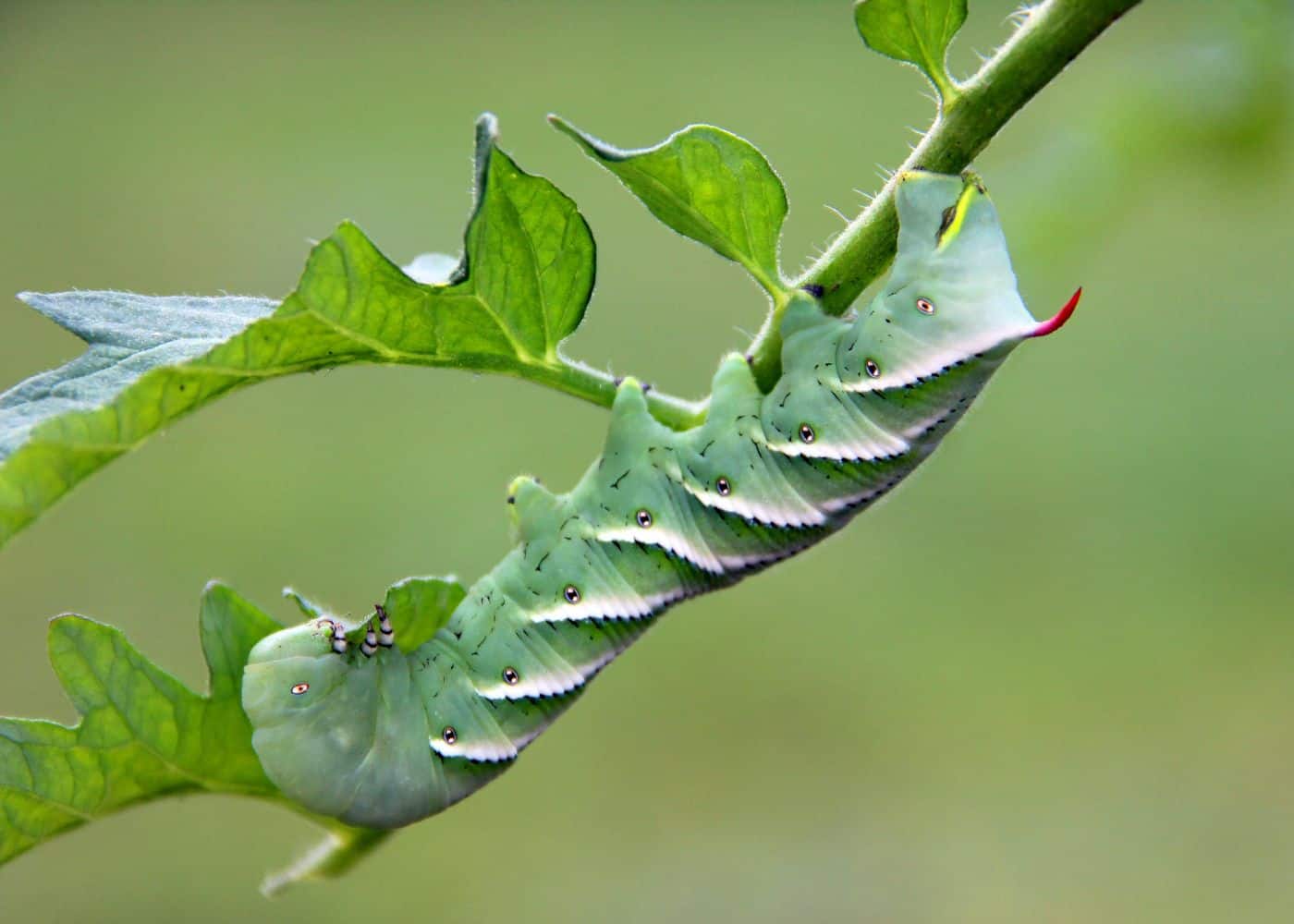
Tomato hornworms are big green caterpillars that eat tomato plants. A few hornworms can strip the leaves off a plant in days. They are hard to see, since they match the leaves, but they are easy to control once you find them.
How to identify tomato hornworms
- Bright green caterpillar, up to about 4 inches (10 cm) long
- A pointed horn at the back end
- White V-shaped marks along each side
The tobacco hornworm looks almost the same and eats the same plants. It has straight, diagonal white stripes along its sides and a red horn. Both are controlled the same way.
The adults are large moths called sphinx moths or hawk moths. They fly at dusk and hover at flowers like hummingbirds. Females lay single, round, pale green eggs on the leaves.
Plants hornworms attack
Hornworms feed on plants in the nightshade family:
Signs of tomato hornworms
- Leaves stripped from the tops of plants, leaving bare stems
- Dark green or black droppings on the leaves and soil below
- Chewed spots on green tomatoes
Droppings are often the first thing you see. When you find them, look on the leaves and stems right above.
How to find hornworms
Hornworms are hard to spot. They are green, they stay still, and they hang under leaves and along stems. These tricks help:
- Look in the early morning or evening, when they feed on the outside of the plant.
- Follow the droppings up to the bare stems above.
- Check at night with a UV flashlight. Hornworms glow under ultraviolet light, which makes them easy to see.
How to get rid of tomato hornworms
1. Pick them off by hand
Hand-picking is the simplest control. Hornworms look scary, but they do not sting or bite. The horn is harmless. Pull them off the plant and drop them into a bucket of soapy water. If you keep chickens, they will eat them.
Check your plants every few days from midsummer on.
2. Leave the ones with white cocoons
If you find a hornworm with small white cocoons on its back, leave it in the garden. Those cocoons belong to a tiny parasitic wasp. The wasp larvae fed inside the hornworm, which stops feeding and dies. When the wasps hatch, they go on to lay eggs in more hornworms.
Here is more on beneficial insects that eat garden pests.
3. Spray Bt on young caterpillars
Bt (Bacillus thuringiensis var. kurstaki) is a natural bacterium that kills caterpillars. It works best on small, young hornworms. Spray the leaves in the evening, since sunlight breaks it down. It does not harm people, pets, bees, or ladybugs.
4. Till the soil in fall or spring
Hornworms spend the winter as brown pupae in the soil. Turning the top few inches of soil after harvest or before planting exposes the pupae to cold and birds. That means fewer moths next summer.
5. Rotate your crops
Do not plant tomatoes, peppers, eggplant, or potatoes in the same spot every year. Moving them helps cut down on the pupae waiting in the soil.
When do hornworms show up?
Hornworms show up from midsummer on, once the moths start laying eggs. In northern gardens, there is often one generation a year. In warmer areas, there can be two or more. A caterpillar feeds for about 3 to 4 weeks before it drops to the soil to pupate.
Other tomato problems
Not every tomato problem is a pest. These posts can help:
For other common pests, see my guide to garden pests.
Seed companies I like
These are the seed companies I order from for my own garden.
- Botanical Interests: beautiful packets with growing notes printed inside
- High Mowing Organic Seeds: certified organic, grown in Vermont
- True Leaf Market: big selection of hybrids, microgreens, and cover crops
Some links earn me a commission at no cost to you. As an Amazon Associate I earn from qualifying purchases.



Leave a Reply