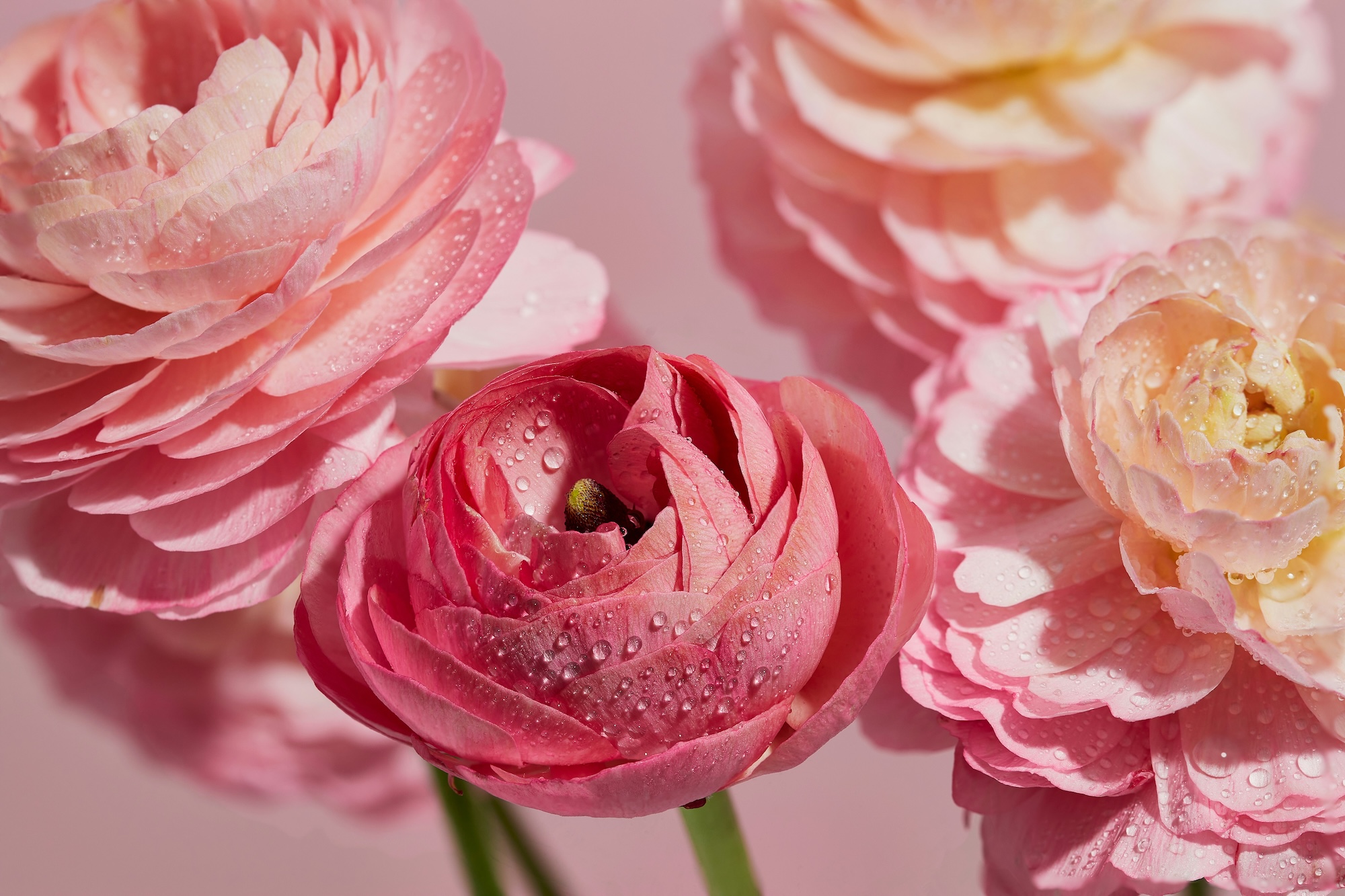
Several flowers closely resemble roses (Rosa spp.) in shape and petal structure. The best alternatives include ranunculus, double peonies, lisianthus, camellias, and certain dahlia varieties. These flowers share the layered, rounded bloom form that makes roses so appealing. The key to finding a convincing rose substitute is choosing fully double cultivars, which have extra rows of petals that mimic the classic rose silhouette. Single or semi-double forms of the same species often look nothing like roses at all.
For bouquets, lisianthus and carnations offer the longest vase life and easiest handling. For garden impact, double peonies and camellias provide the most rose-like appearance on shrubs. Ranunculus works well for spring arrangements when roses are less available.

Ranunculus
Ranunculus (Ranunculus asiaticus) produces tightly layered blooms that strongly resemble garden roses. The flowers come in pink, red, white, yellow, and orange, with thin, papery petals arranged in uniform rows. Ranunculus blooms are smaller and more delicate than most roses, typically 3 to 5 inches across, with a soft, airy quality.
As cut flowers, ranunculus last 5 to 7 days when kept cool and well-hydrated. The hollow stems can bend, so handle them gently. They pair beautifully with roses in spring bouquets but are more sensitive to warm temperatures. Keep them out of direct sun and away from heat sources for best results.

Double peonies
Double peonies (Paeonia lactiflora) look remarkably similar to old-fashioned garden roses at peak bloom. Both produce large, rounded flowers with many layers of ruffled petals. Double peony cultivars like ‘Sarah Bernhardt’ and ‘Bowl of Beauty’ form massive blooms the size of small bowls, often more dramatic than any rose. Unlike roses, peonies bloom for only a short season in late spring to early summer.
In bouquets, peonies make a strong visual impact but require more care than roses. Their vase life is shorter, typically 3 to 5 days, and they can wilt quickly without proper conditioning. Cut them when buds are soft like marshmallows and place stems in deep water. Peonies often anchor bridal and seasonal arrangements but are not available year-round.

Double tulips
Double tulips (Tulipa spp.) have extra rows of petals that give them a rounded, layered appearance similar to small peonies or garden roses. Standard tulips have only six petals, but double cultivars like ‘Angelique’ and ‘Mount Tacoma’ can have 20 or more. The petals are smooth and waxy with clean edges. Tulips maintain a more upright posture than roses, and their leaves are broader and glossier.
Double tulips have a vase life of about 5 days. They continue growing in the vase and may curve or bend toward light, which can change the arrangement’s shape. While less predictable than roses, they work well in spring bouquets paired with other cool-season flowers. They are not ideal for long-lasting displays but offer great impact when fresh.

Lisianthus
Lisianthus (Eustoma grandiflorum) is often mistaken for small roses because of its soft, layered petals and similar bloom shape. The flowers come in romantic shades including pink, lavender, white, and bicolor combinations. Lisianthus blooms are more delicate in appearance than roses, with thinner stems and a fluttery, open look. Multiple blooms appear in clusters on each stem.
Lisianthus performs excellently in bouquets. The flowers have a vase life of 7 to 10 days and hold up well in floral foam or water. They resist wilting and require minimal care compared to many other cut flowers. While the stems are not as sturdy as roses, lisianthus works well in both mixed and single-variety arrangements. They are especially popular in summer wedding florals.

Gardenias
Gardenias (Gardenia jasminoides) have thick, creamy petals arranged in a spiral pattern that forms either a tight swirl or a full double bloom. The flowers are bright white with glossy green foliage. Gardenias are known for their intense fragrance, which is stronger and more tropical than that of most roses. The scent alone makes them memorable in any setting.
As cut flowers, gardenias are delicate and far less dependable than roses. They bruise easily and brown quickly once picked. Their vase life is short, usually just 2 to 3 days, and they require high humidity and careful handling. Gardenias work best floating in water for display or worn as corsages rather than in traditional bouquets.

Carnations
Carnations (Dianthus caryophyllus) have many-petaled blooms with a frilled, ruffled appearance. The petals are thinner than rose petals and often have serrated edges, giving them a textured look distinct from the smooth structure of roses. Carnations come in a wide range of colors and are sometimes dyed for dramatic effect. To achieve the most rose-like appearance, choose solid-colored, fully double cultivars and group multiple stems together for fullness.
Carnations are among the most dependable cut flowers available, rivaling roses in reliability. They have an exceptional vase life of 1 to 2 weeks and tolerate a range of conditions. They resist wilting, are easy to work with in arrangements, and remain affordable throughout the year. While sometimes considered less glamorous than roses, carnations are ideal for long-lasting, budget-friendly floral designs.

Camellias
Camellias (Camellia japonica) can look strikingly similar to roses at first glance. Both have layered petals and a rounded bloom shape. Camellias often have a more symmetrical, structured form with smooth, slightly waxy petals. They come in shades of pink, white, and red, and some fully double varieties look like perfect porcelain rosettes. Camellias bloom in late winter to early spring when few other flowers are available.
Camellias are not nearly as reliable in cut flower arrangements as roses. They do not last as long and are quite delicate once cut. The blooms bruise easily and may brown at the edges. If using camellias in arrangements, handle them gently and keep them in water. They are best enjoyed on the shrub or floated in shallow bowls.

Dahlias
Dahlias (Dahlia spp.) are striking flowers with geometric bloom structures. Rows of pointed or rounded petals form full, rounded shapes that range from pompoms to starbursts to dinner plates. They come in nearly every color except blue and in sizes from 2-inch miniatures to 10-inch giants. Most dahlias have no scent. To find rose-like dahlias, look for ball or pompon types with tightly packed, rounded petals.
Dahlias are not as dependable in bouquets as roses. They are sensitive to heat, dry air, and lack of water. For best results, cut them early in the day and place stems in water immediately. Their vase life ranges from 4 to 6 days depending on the variety. Some dahlia types hold up better than others, but in general, they require more attention than roses as cut flowers.

Begonias
Double-flowered tuberous begonias (Begonia × tuberhybrida) resemble small roses with their rounded, layered blooms. The petals are more fragile than rose petals, and the plants have fleshy, asymmetric leaves. While roses grow upright, begonias usually grow low and spread outward or trail from containers. The flowers come in shades of red, pink, orange, yellow, and white.
Begonias are not well-suited to bouquets. They are better left in pots or garden beds where their beauty can be appreciated in place. Their stems are soft and short, and the blooms wilt quickly when cut. They may last a short time floating in a shallow bowl but are generally not used in cut flower arrangements due to their fragility.

Double impatiens
Double impatiens (Impatiens walleriana) are sometimes called rosebud impatiens for their rounded, layered appearance. These flowers are small, about the size of a quarter, and form compact blooms with multiple rows of soft petals. From a distance, especially in pink or red varieties, they can look like miniature roses. Double impatiens bloom continuously in shade, unlike roses which require full sun.
Double impatiens are not useful in cut arrangements. Their flowers have short stems and wilt quickly when picked. They are best grown as bedding or container plants, where they bloom steadily throughout the season in shaded locations. They do not thrive in full sun or dry conditions, making them a good choice for spots where roses would struggle.

Rhododendrons
Rhododendrons (Rhododendron spp.) look very different from roses up close, but they serve similar purposes in landscape design. Rhododendron flowers grow in large clusters and are trumpet-shaped rather than layered. Their petals are thinner than rose petals, and the blooms are looser, often with spots or color gradients inside. The overall effect is more informal than the structured form of a rose.
Like roses, rhododendrons are typically shrubs. While many grow quite large, newer compact cultivars are now available for smaller spaces. Rhododendrons tolerate shade better than roses, making them a good choice where there is not enough sun for optimal rose blooming. The thick, leathery evergreen leaves provide year-round interest. In bouquets, rhododendrons do not perform well because the stems are bulky and the blooms wilt quickly.

Cotton rose hibiscus
Cotton rose hibiscus (Hibiscus mutabilis) forms large, ruffled double blooms that closely resemble peony-style roses. The flowers are usually white, pink, or both, and may change color throughout the day as they mature. The petals are softer and more delicate than rose petals, with a looser structure. This tropical shrub blooms in late summer and fall.
Cotton rose hibiscus is not well-suited for cut arrangements. The flowers wilt within a day, even when placed in water. They are best admired on the plant in the garden. Like other hibiscus varieties, each bloom is short-lived, but the plant produces flowers continuously over a long season. They are grown for garden display rather than floristry.

Poppies
Poppies (Papaver spp.) may be mistaken for roses when seen from the side, especially double-flowered varieties in pink shades. However, poppies and roses are very different in form. Poppies have large, crinkled petals that create a bowl-like or cup shape. Their look is airy and bold, with a prominent center of stamens. The stems are thin and fuzzy, and the overall impression is lighter and more wild than a rose.
Poppies are very delicate as cut flowers. They have a vase life of only 1 to 3 days and require searing of the stem ends in boiling water or with a flame to help them take up water. While beautiful in the garden, poppies are challenging to work with in bouquets and often do not hold up well. They are best enjoyed where they grow.

Japanese quince
Japanese quince (Chaenomeles speciosa) does not look exactly like a rose, but it shares several qualities with rose shrubs. Both have thorny branches and produce flowers that attract pollinators like butterflies, bees, and hummingbirds. Japanese quince blooms in red, bright orange, pink, and white. The flowers have a simple, clean shape and often appear before the leaves emerge in early spring.
In arrangements, flowering quince can last up to a week if cut when buds are just beginning to open. The woody stems add structure and interest to bouquets. While the individual flowers are not long-lasting compared to roses, the branches are sometimes used in spring floral work for their color, strong lines, and early bloom time when other flowers are scarce.

Moss rose
Moss rose (Portulaca grandiflora) has almost nothing in common with true roses despite the name. This succulent produces small, rose-like blooms with paper-thin petals. The flowers open in the sun and often close at night or on cloudy days. They come in bright colors like hot pink, orange, yellow, and white. The plant has a trailing habit with fleshy, needle-like leaves.
Moss rose is not used as a cut flower. The blooms wilt quickly once picked and are meant to be enjoyed in the garden or container planter. While the flower shape may resemble tiny roses, the behavior is entirely different. Moss rose is grown for ground cover and color in full-sun areas with poor, dry soil where few other flowers thrive.
Choosing rose alternatives for your situation
The best rose alternative depends on how the flowers will be used. For bouquets and cut flower arrangements, lisianthus and carnations offer the best combination of rose-like appearance and long vase life. Ranunculus and double tulips work well for spring arrangements. For garden display, double peonies, camellias, and dahlias provide dramatic rose-like blooms on attractive plants. For shady spots where roses would fail, consider double impatiens, begonias, or rhododendrons.
Remember that cultivar selection matters significantly. Fully double cultivars with extra rows of petals most closely resemble double roses. Single or semi-double forms of the same species often look nothing like roses at all. When shopping for plants or cut flowers, look for varieties specifically described as double, fully double, or peony-flowered to get the most rose-like appearance.



Leave a Reply