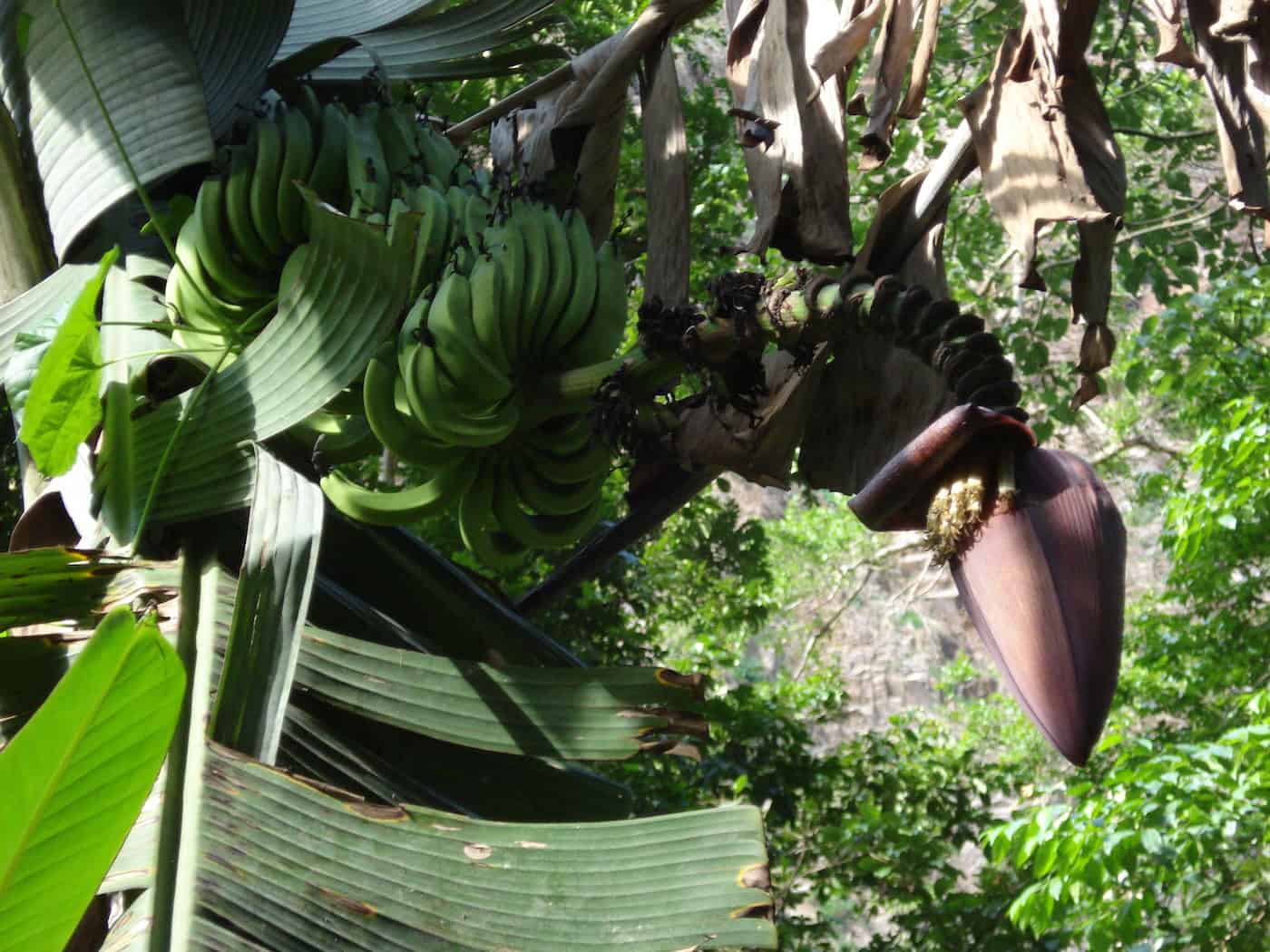
Bananas are fast-growing tropical plants with big, long leaves. The plants are usually about 15 feet tall, but there are dwarf varieties that are more like 6-10 feet tall (and giant ones that tower over 20 feet!).
While banana plants look like trees, they’re not true woody trees. Bananas are botanically classified as herbaceous plants (and are the largest flowering herbaceous plants in the world).
Rather than having a true trunk, the upright stalks are formed by tightly packed concentric layers of leaf sheaths. These pseudostems grow up from a big underground stem called a rhizome. Normal-looking roots come off the rhizome and collect moisture and nutrients from the soil.
First, the plant grows tall leaves. Then, a big pointy flower called an inflorescence appears at the top. The inflorescence has tiny flowers inside that turn into bananas. The bananas start off small and green, then grow bigger and turn yellow when ready to eat.

Banana tree basics
Banana trees are herbaceous perennial tropical plants from the Genus Musa, specifically Musa acuminata, Musa balbisiana, and their hybrids. Generally growing to about 15 feet tall, these vigorous plants flower in clusters that develop into bunches of bananas when pollinated.
Banana trees are native to tropical & subtropical Asia. They grow easily in many tropical countries, where the climate is moist, but frosts are rare. Banana trees are damaged by cold temperatures and only grow in warm, humid parts of the world.

Banana tree domestication and history
The common banana is believed to have been domesticated in the Papua New Guinea region nearly 10,000 years ago. Bananas are not commercially grown in America, so they must be imported, which did not become common until the early 1900s.

Trunks of banana trees
Banana trees, lacking wooden bark, are not technically trees as they are not true woody plants. Instead, they are green-leaf herbaceous plants. The part that looks like a trunk or a stem is actually made of tightly-packed, overlapping leaves.
The banana plant is one of the fastest-growing plants in the world, able to grow five feet in a single day under the right conditions. Some varieties can grow to reach a total height of over 20 feet.

Leaves of banana trees
From the top of the banana plant, very large spear-shaped leaves emerge from the stem, each leaf blade measuring up to two feet wide and nine feet long. These leaves easily split in the wind, giving the leaf a look similar to a palm frond.

Fruit of banana trees
Once banana plants reach maturity and can produce fruit, a flower stem will emerge near the top of the adult plant. This is called the banana heart, and at the base of this heart will be the cluster of banana fruit.
Each mature banana plant produces up to 200 banana fruits within a year. Once the fruit matures, the banana stem dies while the roots continue to live. This makes them perennial herbs, which grow back each year.

Seedless bananas
The fruit of banana plants is technically a berry, having a fleshy fruit with seeds and no pit. Native, wild banana trees have a fruit that contains a lot of hard, pea-sized black seeds. The flesh around the banana seed is edible, but there isn’t a lot of flesh in each fruit. Eating wild bananas is tedious.
Over time, through selective reproduction, humans have changed the genetics of the commercial banana tree to eliminate banana seeds from the fruit. While still considered a berry, the modern banana is seedless and sterile. Since they do not have viable seeds, a grocery store banana cannot sprout and grow banana plants.

Vegetative reproduction
When the banana fruit cluster of a tree is harvested, the leaves and stem die, but the roots of the mother plant stay alive. New stem sprouts emerge from the main banana plant roots, which will grow into a new banana tree, and the life cycle will continue.
It is common to find a young plant growing near the bottom of an adult. A farmer will often cut down the dying stem after harvest and let the new baby plants grow. In 6-10 months, the new plant will be ready to produce another banana bunch.
Farmers can increase the number of trees they are growing by digging up sprouts, or pups, and transplanting them to a new planting site. This is asexual reproduction via the division of the parent plant.

Bananas in your garden
Commercial banana farms do not thrive in America because, according to New Mexico State University, the banana tree is not tolerant to cold weather. The tree stops growing if the temperatures drop below 55 degrees Fahrenheit, the fruit gets damaged at around 32 degrees, and the banana rhizome, or collection of roots dies at around 22 degrees.
Homeowners in southern climates may be able to grow bananas in their garden, provided measures are taken to protect bananas in the rare case the temperatures fall to freezing. This may include bringing them inside, covering them, or applying heat lights.

A more popular option for American gardeners is the ornamental banana tree, a species different from the fruiting dessert banana grown commercially. Ornamental banana trees have the same tropical look as commercial trees but do not produce edible fruit. These ornamental versions are more resistant to cold weather and better suited to temperate regions.




Leave a Reply